

For most of 2026, freight rates have improved faster than freight demand.
Tighter capacity pushed spot rates higher through spring and summer, and contract rates followed later. August then brought a sharp correction, raising the question of whether the recovery was beginning to fade.
September suggests otherwise.
Spot rates recovered across dry van, reefer, and flatbed, contract rates continued climbing, and capacity remained tight. At the same time, freight demand finally produced its first meaningful positive signal in more than three years.
That doesn’t mean demand has fully recovered. But heading into Q4, the market looks materially stronger than it did at the beginning of the year.
The Freight Market Has Repriced. Now Demand Has to Catch Up.
The year-to-date rate trend shows how much the market has changed.
According to DAT Trendlines, national all-in dry van spot rates rose from $2.32 per mile in January to $3.01 in July. Reefer climbed from $2.81 to $3.42, while flatbed moved from $2.58 to $3.64.
All three declined in August, but the correction did not continue in September.
| Equipment | January | July | August | September |
| Dry Van | $2.32 | $3.01 | $2.90 | $3.00 |
| Reefer | $2.81 | $3.42 | $3.36 | $3.61 |
| Flatbed | $2.58 | $3.64 | $3.55 | $3.60 |
Source: DAT Trendlines. National average all-in spot rates, including fuel surcharges.
Dry van recovered 10 cents in September, flatbed gained 5 cents, and reefer climbed 25 cents to its highest monthly all-in spot average of 2026.
FreightWaves’ SONAR data supports the same broader picture. Tender rejections remained around 14% in late September even as freight volumes stayed uneven.
The market is not being supported by booming demand. It is still being supported largely by limited capacity.
Capacity Is Still the Stronger Side of the Equation
DAT’s load-to-truck ratios remained elevated in September.
Dry van averaged 10.98 loads per truck, up from 10.34 in August. Flatbed increased from 36.70 to 38.23. Reefer eased from 19.84 to 18.88, but remained well above September 2025’s 10.95.
The Logistics Managers’ Index points in the same direction. Transportation Capacity stood at 40.0 in August, up from 28.4 in July but still below the 50-point threshold that indicates expansion. Transportation Utilization rose to 70.6, while Transportation Prices reached 90.0.
In other words, the pace of capacity contraction eased in August, but the market remained tight.
That is why the next question matters so much: is demand finally beginning to improve too?
Freight Demand Finally Gave Us Something to Watch
The Cass Freight Index reported that shipments increased 2.1% year over year in August, its first year-over-year increase since January 2023 and the end of a 42-month downturn by that measure.
That is meaningful, but it is not enough to call a demand recovery.
Cass noted that August’s improvement largely reversed declines from June and July. ATA’s For-Hire Truck Tonnage Index also remained weak, falling 0.5% in August and 1.6% from a year earlier.
So demand is still sending a mixed signal.
If shipment volumes continue improving while capacity stays tight, demand could begin reinforcing a market that has so far been supported mainly by fewer available trucks.
If not, capacity will continue doing most of the work.
Spot Moved First. Contract Rates Are Catching Up.
Another important shift is happening outside the spot market. Contract rates keep increasing.
DAT Trendlines shows dry van contract rates increasing from $2.49 per mile in January to $3.24 in September. Reefer increased from $2.81 to $3.58, while flatbed climbed from $3.02 to $4.06.
FreightWaves’ analysis of the Cass Truckload Linehaul Index supports that trend. The index increased 11.3% year over year in August, marking its twentieth consecutive year-over-year increase.
Contract rates generally respond more slowly than spot rates. Their continued rise suggests that the tightening first visible in the spot market is increasingly being reflected in longer-term pricing.
That’s important heading into Q4 because it moves us beyond simply asking whether this week’s spot rate is up or down. The broader pricing environment has changed. The question now is whether freight demand can sustain it.
Diesel Is Taking Back Part of the Rate Gain
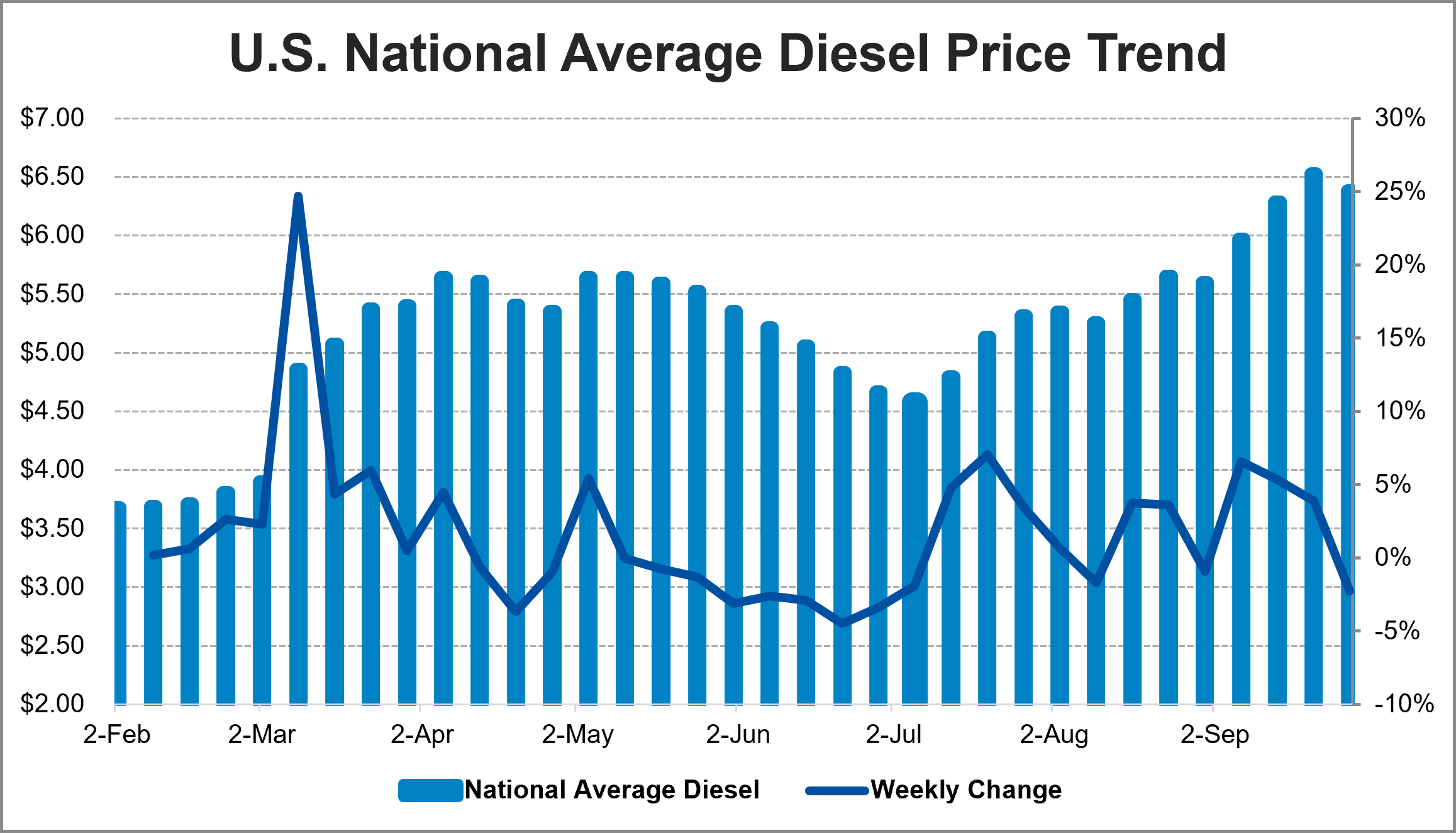
Better rates don’t automatically mean better margins. Diesel made that especially clear in September.
According to the U.S. Energy Information Administration, the national average rose from $5.60 per gallon on August 31 to $5.97 on September 7, $6.29 on September 14, and $6.53 on September 21.
Prices finally eased during the last week of the month, falling to $6.38 per gallon on September 28.
That still leaves diesel about 78 cents per gallon higher than it was at the end of August, an increase of nearly 14% in four weeks.
For a truck averaging 6.5 MPG, that difference alone adds roughly 12 cents per mile to fuel cost.
That is why rate comparisons alone can be misleading. A rate can look considerably better than it did a few months ago, but what matters is how much margin it leaves after today’s operating costs.
Freight Fraud Is Becoming More Targeted
Cargo theft and freight fraud remain significant risks, and recent data suggests criminals are becoming increasingly sophisticated.
Verisk CargoNet recorded 677 supply chain theft incidents during Q2 2026, down 26% from the same quarter last year.
But the financial impact moved sharply in the opposite direction.
Estimated losses reached $304.6 million, more than double the $135.7 million recorded in Q2 2025.
The concern isn’t simply the number of stolen loads. Criminal groups are using increasingly sophisticated methods to target and redirect valuable freight.
CargoNet says business email compromise and shipment misdirection schemes remain persistent threats. The FBI has also warned that cyber-enabled cargo theft can involve compromised carrier accounts, fraudulent load postings, business impersonation, and the rerouting of legitimate shipments.
For carriers, verification matters as much as speed.
Before accepting an unfamiliar load:
- Verify broker and carrier information through independent sources.
- Be cautious when contact details, pickup instructions, or payment information change unexpectedly.
- Protect login credentials and business email accounts.
- Confirm suspicious instructions using a known phone number rather than the contact information in the questionable message.
- Check broker credit before hauling.
A $3-per-mile load isn’t a good load if the company behind it isn’t legitimate or can’t pay the invoice.
What Should Carriers Watch in Q4?
The freight market entering Q4 looks considerably different from where it started in 2026.
Spot rates are higher, contract rates have followed, and available capacity remains tight. Tender rejections continue to show limited slack in the market. And, for the first time in more than three years, the Cass Freight Index has recorded year-over-year shipment growth.
But there are still reasons for caution.
ATA’s tonnage data remains weak. Freight demand is still uneven. September’s diesel increase absorbed part of the improvement carriers have seen in rates. And high operating costs continue to pressure smaller carriers, contributing to the capacity constraints supporting today’s market.
So October isn’t about declaring the freight recession over. It’s about recognizing that the market has already repriced before demand has fully recovered.
For carriers, that creates opportunity, but it also makes selectivity more important.
Know your current cost per mile. Watch the lanes you operate. Account for fuel and deadhead. Consider where the next load will come from before accepting the current one. Verify who you’re hauling for. And judge every load by the margin it leaves, not simply by how much better the rate looks than it did last year.
Q4 should tell us whether freight demand is finally ready to join the recovery.
Better Opportunities Still Require Predictable Cash Flow
As rates and operating costs move higher, working capital becomes even more important.
Fuel is the clearest example. When diesel rises rapidly, the amount of cash required to keep a truck moving changes immediately, while broker payment terms don’t.
That matters when deciding which loads to accept, how much freight you can move, and whether you have enough flexibility to wait for a better opportunity instead of taking the next available load simply to generate cash.
Freight factoring can help close that timing gap by turning completed loads into working capital sooner.
For carriers already using freight factoring, this is also a good time to evaluate whether their current provider supports the way they operate. Are payments predictable? Are fees transparent? Can you check a broker’s credit before accepting a load? Do you have someone available when you need support?
At Summar Financial, carriers have access to same-day funding, unlimited broker credit checks, dedicated account support, and transparent pricing.
Freight factoring cannot make a bad load profitable or protect you from every risk on the road. But the right factoring partner can make one important part of your business more predictable: when you get paid.
Contact Summar Financial to see how your current factoring solution compares.