
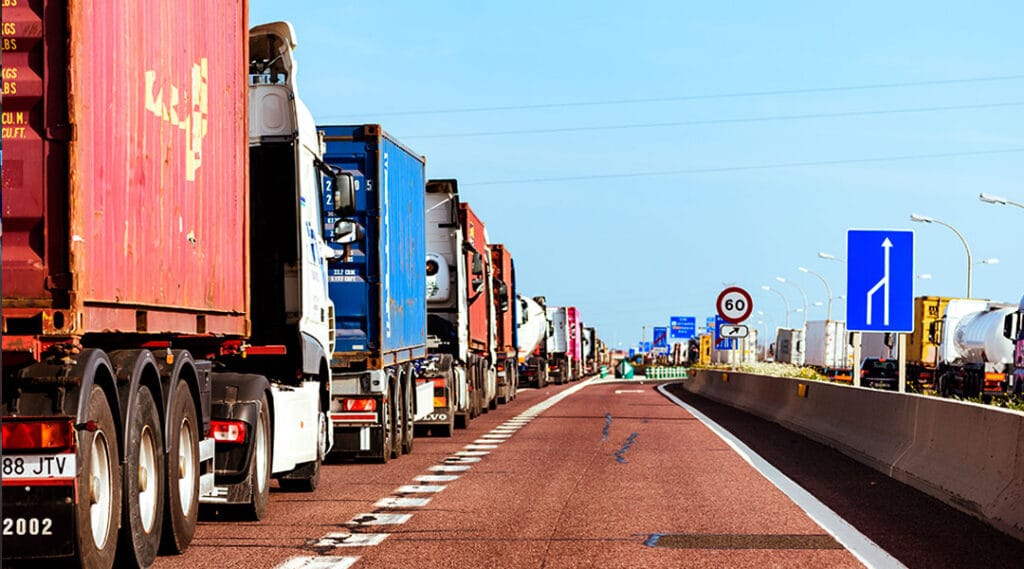
Freight congestion is not just a traffic issue. For trucking companies, it is a structural cost multiplier that directly affects transit times, driver productivity, fuel consumption, and ultimately your margins.
Every year, the American Transportation Research Institute (ATRI) publishes the Top 100 Truck Bottlenecks, the most authoritative congestion dataset in the U.S. freight industry. The 2026 update confirms a major shift at the top and reinforces a long-standing reality: congestion increasingly concentrates in major freight corridors where demand, population growth, and infrastructure limits collide.
This analysis breaks down the worst truck bottlenecks in the U.S. in 2026, explains how they affect your operation on the road, and explores how congestion translates into real financial pressure for carriers.
What Is ATRI’s Truck Bottleneck Ranking?
Atri analyzes billions of anonymized GPS truck speed records across more than 325 freight-critical highway locations nationwide to understand how freight actually moves through the network. The ranking evaluates:
- Average truck speeds
- Peak versus non-peak congestion
- Delay intensity
- Reliability deterioration over time
Because the analysis is based on real truck activity rather than general traffic estimates, the ATRI bottleneck list has become one of the most trusted indicators of freight congestion in the United States.
The rankings highlight where trucks consistently lose time, where schedules become unpredictable, and where operating efficiency takes the biggest hit.
For you as a carrier, that lost time is not abstract. It shows up as higher fuel burn, fewer productive hours, missed delivery windows, and tighter cash flow.
ATRI’s report doesn’t just show where traffic is worst. It shows where trucking profitability is under the most pressure.
2026 Top 10 truck bottlenecks (ATRI)
According to the ranking, the most severe truck bottlenecks in the United States are:
- Chicago, IL (I-294 at I-290/I-88)
- Fort Lee, NJ (I-95 at State Route 4)
- Atlanta, GA (I-285 at I-85 North)
- Houston, TX (I-45 at I-69/US 59)
- Atlanta, GA (I-75 at I-285 North)
- Atlanta, GA (I-20 at I-285 West)
- Nashville, TN (I-24/I-40 at I-440 East)
- Houston, TX (I-10 at I-69/US 59)
- Cincinnati, OH (I-71 at I-75)
- McDonough, GA (I-75)
See the full list at: Top 100 Truck Bottlenecks – 2026
These locations sit at the core of U.S. freight movement, connecting ports, distribution hubs, manufacturing centers, and dense consumer markets. When congestion persists at these interchanges, it slows freight far beyond the immediate metro area and affects carriers running multiple lanes nationwide.
What Changed in 2026
The most important shift in the 2026 rankings is Chicago replacing Fort Lee as the nation’s worst truck bottleneck. This reflects growing freight pressure through Midwest logistics hubs, where multiple interstate corridors converge around major rail terminals, warehouses, and distribution centers.
Beyond that change, the broader congestion pattern remains stable. Texas and Atlanta continue to dominate the list, confirming that Sunbelt freight growth and urban expansion are still outpacing highway capacity.
The same locations appearing year after year show that truck bottlenecks are structural. They are part of the operating environment, not temporary disruptions.
The True Cost of Congestion in Trucking
In trucking, congestion rarely affects just one load. A slow interchange can cascade through your entire operation.
Traffic delays trigger a chain reaction:
- Late deliveries strain broker and customer relationships.
- Missed reload windows reduce revenue.
- Longer transit times delay invoicing and payment.
When your truck stops, your revenue stops with it, for small carriers running tight margins, that lost time quickly turns into pressure on fuel, insurance, maintenance, and payroll.
ATRI’s 2026 data shows the scale of this impact across the industry:
- Congestion delays equal 436,000 drivers sitting idle for a year
- Trucks burn 6.4 billion gallons of diesel in traffic
- Congestion adds $109+ billion annually to U.S. supply chain costs
For large fleets, this erodes network efficiency.
For small carriers, it raises cost per mile and tightens cash flow every time a driver enters a Top 100 bottleneck zone.
Read more: Route-Planning and Deadhead Miles in Trucking: Challenges and Solutions.
How Congestion Creates a Cash Flow Crisis
If you run freight through major hubs like Chicago, Houston, or Atlanta, congestion isn’t occasional. It’s built into your lanes.
That means its financial impact is built into the business too.
Longer transit times, higher fuel burn, and delayed load completion compress working capital. Over time, this reduces your financial flexibility and increases exposure to payment timing.
Carriers with stronger liquidity can absorb delays without disrupting fuel purchases, payroll, or maintenance. Those without it feel congestion more sharply, because every hour lost on the road also tightens available cash.
In high-congestion freight markets, cash-flow stability becomes a competitive advantage.
Staying Profitable: How Factoring Keeps You Moving
The 2026 ATRI rankings confirm what most carriers already know: congestion concentrates in the corridors that move the most freight — Chicago, Houston, Atlanta, Dallas, and Los Angeles.
If you operate in these markets, delays are not occasional. They’re part of the job. That makes cash-flow stability just as important as routing or dispatch strategy.
Freight factoring helps offset that structural pressure. By turning delivered loads into immediate working capital instead of waiting weeks for broker payment, you maintain liquidity even when transit times stretch and costs rise.
In congested freight networks, faster access to cash keeps fuel, payroll, and maintenance moving without disruption.
Summar Financial supports trucking companies with factoring solutions built for these realities, providing fast funding and financial flexibility so you can operate with confidence, even when traffic slows your times.
With Summar, you can:
- Receive same-day payments on approved invoices
- Choose from true non-recourse plans that protect you from broker non-payment
- Extend your risk protection beyond the typical 90-day limit with Summar Shield.
- Access tools like a free TMS, insurance partners, dispatch support, and fuel savings programs
This means you stay in control of your finances, even when you’re stuck in traffic.
Explore how Summar can help your trucking business overcome delays and stay financially strong.
Learn more about our freight factoring services or contact us to get started.