

Most months, freight market conversations start with rates and diesel.
Both are still relevant in September. Spot rates continued cooling through August, while diesel climbed back to its highest level since May. But some of the month’s most important developments are happening somewhere else.
FMCSA is moving to formally codify the English-language proficiency enforcement policy already used at roadside inspections. At the same time, a federal lawsuit over access to CDLIS data is raising questions about how commercial-driver information can be used and shared.
Neither development changes what a load pays today.
But both are relevant because they affect the broader operating environment carriers work in, from driver qualification to how commercial-driver data is handled.
September reminds us that protecting your operation requires looking beyond rate per mile.
FMCSA Moves to Codify Current English-Proficiency Enforcement
FMCSA proposed a rule on August 10 that would formally codify its current English Language Proficiency enforcement policy. Commercial drivers already must meet federal English-proficiency requirements, and drivers who fail the current roadside assessment can already be placed out of service.
The proposal would not materially change what carriers or drivers must do today. Instead, it would codify the existing out-of-service consequence in federal regulation, aligning the rules with current CVSA enforcement criteria and making the policy harder to reverse through future administrative guidance.
For carriers, the takeaway is continuity rather than a new requirement: English-proficiency enforcement remains an active compliance issue, but the proposed rule does not create a new qualification standard. Instead, it would formalize the current enforcement approach in federal regulation. Guidance can shift with a new memo. Codifying the policy would make it harder to reverse than agency guidance because changing the regulation would generally require another rulemaking process.
A Federal Fight Over 17 million CDL Records
A separate federal dispute could affect how the nation handles commercial-driver information.
On August 13, a coalition of 21 states and the District of Columbia sued DOT and FMCSA over a demand for bulk access to the Commercial Driver’s License Information System, the database holding the Master Pointer Records for roughly 17 million commercial drivers, which include identifying fields such as names, dates of birth, Social Security numbers or alternatives, license numbers, and state-of-record information. The states allege DOT threatened to withhold more than $10 million in federal funding from AAMVA, the nonprofit that operates CDLIS, if it didn’t hand over the full database.
A federal judge sided with the states on August 21, issuing a temporary restraining order that blocks the transfer while the case proceeds. That order doesn’t resolve anything permanently; it holds the current arrangement in place while the court considers a longer-term injunction. The next hearing is scheduled for September 10.
For carriers and drivers, there is no immediate change in compliance. The case is broader: it raises questions about who can access CDL-holder information, for what purposes, and what limits apply to the federal use of data collected through state licensing systems.
The litigation is still in its early stages, so carriers should view it as a development to watch rather than a change that requires action today.
The Market Is Paying More to Move Less
The freight market continued to cool in August, but the data still points to a market constrained more by available capacity than supported by strong freight demand.
DAT’s Late-August Spot Market Snapshot shows spot rates easing across all three major equipment types:
| Segment | Late-August Spot Rate, All-In | July | Change | August Load-to-Truck Ratio |
| Dry Van | $2.90/mile | $3.01 | -11¢ | 9.98 |
| Reefer | $3.36/mile | $3.42 | -6¢ | 19.08 |
| Flatbed | $3.55/mile | $3.64 | -9¢ | 35.75 |
Source: DAT Trendlines. Spot rates are national all-in averages and include fuel surcharges.
August also changed the spot-contract relationship. After spot pricing gained ground against contract rates earlier this summer, contract rates are moving back above spot across dry van, reefer, and flatbed. That does not erase the broader capacity story, but it does suggest that the summer’s spot-market strength should not be treated as the new baseline heading into fall.
Rates clearly moved down from the summer peak, but capacity remains much tighter than in previous years.
Dry van’s August load-to-truck ratio averaged 9.98, compared with 5.81 in August 2025. Flatbed averaged 35.75, versus 20.45 a year earlier. By the week of August 22, reefer’s ratio had also moved back above 20, reaching 20.57.
That distinction matters.
The freight market is not seeing a broad surge in demand. Instead, fewer available trucks continue to support pricing even as seasonal freight activity cools.
Other industry indicators reinforce that picture.
U.S. Bank’s Q2 Freight Payment Index showed shipment volume declining 2.8% year over year, while shipper spending increased 28.1%. Cass reported a similar divergence in July, with freight shipments down 4.8% while its Truckload Linehaul Index increased 8.6%.
The Logistics Managers’ Index also reported significant contraction in transportation capacity.
In simple terms, shippers are paying more to move less freight.
For carriers, that means the current market still offers pricing leverage, but not because every lane is strong. The opportunity comes from constrained capacity, which makes lane selection, deadhead, contract terms, and actual cost per mile more important than simply chasing higher posted rates.
Diesel Is Moving Against Rates Again
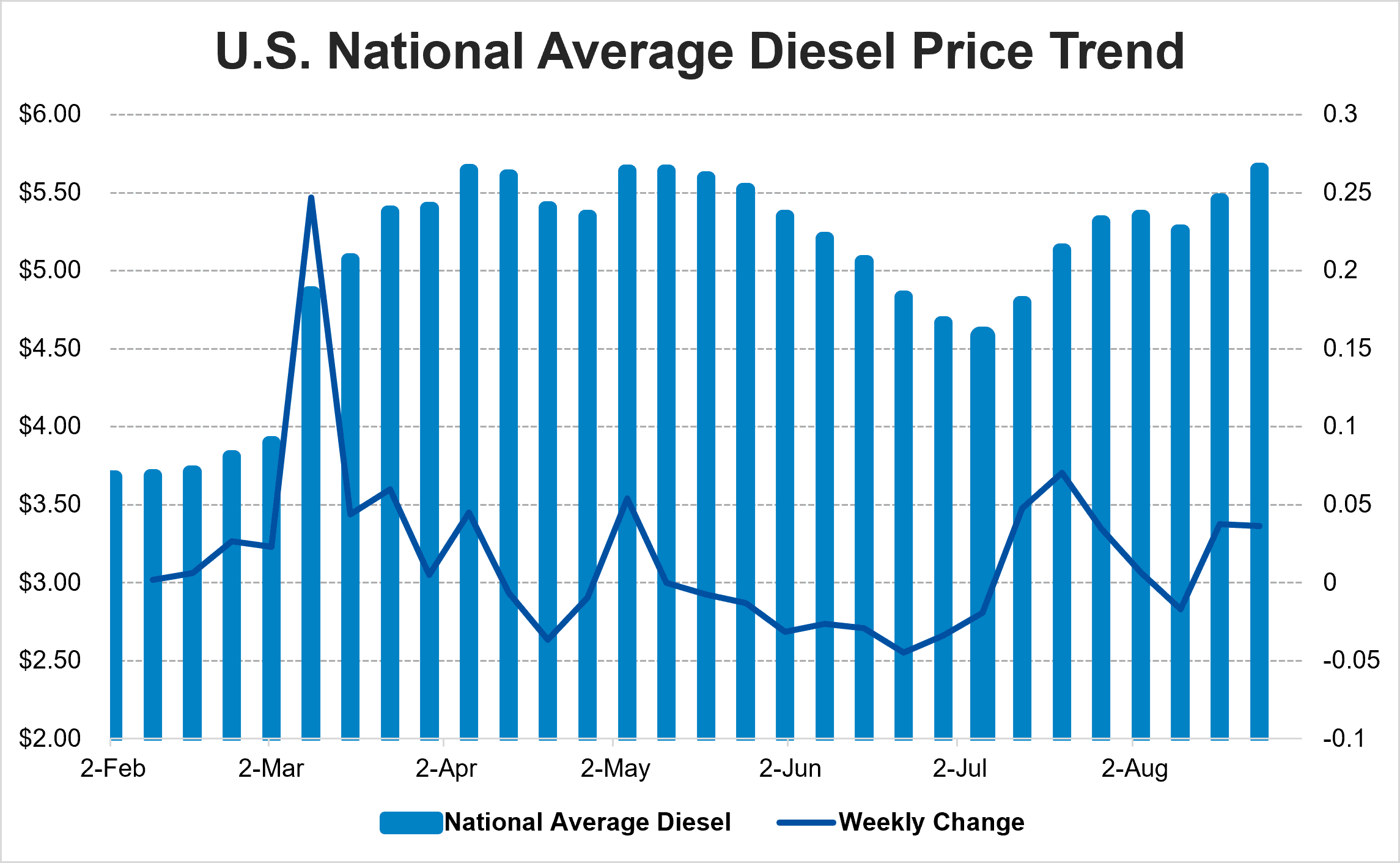
Fuel is making that selectivity even more important.
After falling to $4.58 per gallon in early July, the national diesel average reversed direction and reached approximately $5.65 per gallon by August 24, according to EIA data.
That is more than a dollar of movement in less than two months.
At the same time, spot rates have been easing from their summer highs. That creates an unfavorable combination for carriers: fuel costs are moving higher while the revenue side of the equation is cooling.
The practical response is not to predict diesel. It is to price with current information.
Review fuel costs weekly, understand how much deadhead each load creates, and calculate the full lane rather than looking only at the posted rate per mile. A load that worked at July’s fuel price may produce a very different margin in September.
What September Is Really Telling Carriers
The different stories in this month’s update point toward the same operational reality.
Freight conditions remain significantly stronger than they were a year ago, but the environment is becoming more complicated.
Capacity remains constrained, which supports rates. Demand remains uneven, which limits how far those rates can go. Diesel has moved higher again. At the same time, federal enforcement and legal developments continue adding variables outside the rate market.
For owner-operators and small fleets, that makes operational discipline as important as pricing discipline.
Before taking the next load, consider more than the rate:
- Does the load still meet your margin after current fuel costs and deadhead?
- Is the broker financially reliable?
- Are your drivers and equipment ready for the compliance environment?
- Does the load position the truck for another profitable move?
Tighter capacity and significantly higher year-over-year spot rates have given carriers more leverage. September is a reminder that keeping that advantage requires managing the rest of the operation carefully.
Keep the Financial Side of the Operation Predictable
When rates, diesel, and operating conditions can change quickly, predictable cash flow becomes even more valuable.
For carriers that already use factoring, the question is not simply how quickly invoices are funded. It is whether the factoring relationship helps the operation run efficiently when conditions change.
Look at the full relationship. Are payments predictable? Are fees transparent? Can you check broker credit before accepting freight? Do you have access to someone who can help when an invoice or account issue comes up?
At Summar Financial, carriers get same-day funding, unlimited broker credit checks, dedicated account support, and transparent pricing.
Freight factoring cannot solve a compliance issue or control diesel prices. The right factoring partner can make one important part of the business more predictable: when you get paid.
In a market with enough variables already, that predictability matters.
Contact Summar Financial to see how your current factoring solution compares.