

June delivered what the market had been building toward since November.
Spot rates reached some of their strongest levels in years, with flatbed setting new highs and reefer approaching its 2021 peak. Some shippers are renegotiating contracts they signed only months ago. And diesel, one of the year’s biggest cost pressures, has now fallen more than a dollar from its May peak.
The recovery is no longer just a forecast. Several months of market data now point to a stronger cycle.
But a stronger market does not automatically create stronger margins.
The question entering July is not whether the market improved. It is whether your operation is structured to capture it and protected against the risks that come with it.
The second half of 2026 will not simply reward carriers who run more miles. It will reward carriers who know when to negotiate, verify before they haul, and keep enough cash available to move when the right freight appears.
June Confirmed the Shift, and Early July Held the Momentum
The freight recovery did not arrive overnight.
For months, spot rates climbed as fewer trucks covered more freight. June and early July finally put numbers behind what carriers were already feeling on the road.
| Segment | Spot Rate | Contract Rate | L/T Ratio | MoM Change | Market Condition |
| 🧊 Reefer | $3.47/mile (Jul) | $3.28/mile (Jul) | 21.30 (Jul 4 wk) | -$3.17 Jul vs Jun | Spot above contract. Produce season is keeping capacity tight. |
| 🏗️Flatbed | $3.65/mile (Jul) | $3.74/mile (Jul) | 42.05 (Jul 4 wk) | -$14.89 Jul vs Jun | The rate eased in July. Contract holding firm above spot. |
| 🚛 Van | $3.05/mile (Jul) | $2.92/mile (Jul) | 10.87 (Jul 4 wk) | -$2.01 Jul vs Jun | Spot running above contract. Capacity is tight across major lanes. |
| Tender Rejections | 17.55% peak (Jun) | Highest since 2022 | Nearly 1 in 5 contracted loads are refused by carriers. | ||
| Diesel | $4.58/gallon (Jul 6) | -$1.06 from May 4 peak | 10 consecutive weeks of decline from $5.64 |
The numbers point to a tighter market, but each segment tells a different story. Reefer and van spot rates are running above contract, while flatbed contract pricing remains firm after spot rates eased from their June peak.
Tender rejections reinforce that pressure. They reached 17.55% in June, the highest level since 2022, as carriers rejected more contracted freight and capacity shifted toward the spot market.
Even the July 4 slowdown failed to erase pricing strength.
The common factor is capacity. Fewer trucks are available to cover freight, giving active carriers more leverage and making equipment type, lane selection, and pricing strategy increasingly important.
Contract Renewals Need Current Market Data
Aggregate DAT contract rates rose 9.8% year over year in May, and some shippers have already revisited agreements signed only months earlier.
For carriers with Q3 renewals, the opportunity varies across segments.
Reefer and van carriers can point to spot premiums of 19 cents and 13 cents per mile, respectively. Flatbed carriers have a different argument: contract rates remain near multi-year highs even after spot pricing pulled back from its June peak.
The takeaway is simple. Do not negotiate with last year’s numbers.
Know your cost per mile, current spot pricing in your lanes, deadhead exposure, and fuel costs. Use those numbers to show what it actually costs to cover the freight today.
The market is giving carriers stronger data. Use it at the negotiating table.
What Is Supporting Flatbed and Reefer Demand?
The rate strength in flatbed and reefer comes from different parts of the economy.
Flatbed spot rates rose 68 cents between March and June, from $3.07 to $3.70 per mile, driven by construction, data center development, and manufacturing projects. June’s ISM Manufacturing PMI reached 53.3, marking a sixth consecutive month of expansion, giving flatbed a broader industrial demand base that goes well beyond short-term seasonal freight.
Reefer remains more closely tied to the produce season. Agricultural activity across California, the Southeast, and other key markets continues to pull refrigerated equipment into produce-heavy lanes, tightening available capacity.
For carriers, this makes positioning critical.
Flatbed carriers should watch industrial and construction corridors. Reefer carriers should evaluate both sides of the lane before chasing a strong outbound rate.
A premium headhaul can quickly lose value if the return market leaves you with excessive deadhead.
The rate matters. The full lane matters more.
Diesel Relief Is Real, but Fuel Strategy Still Matters
Diesel continues moving in the right direction.
After reaching $5.64 per gallon in May, the national average fell to approximately $4.58 per gallon by July 6. That represents a cumulative decline of $1.06 and the 10th consecutive weekly drop.
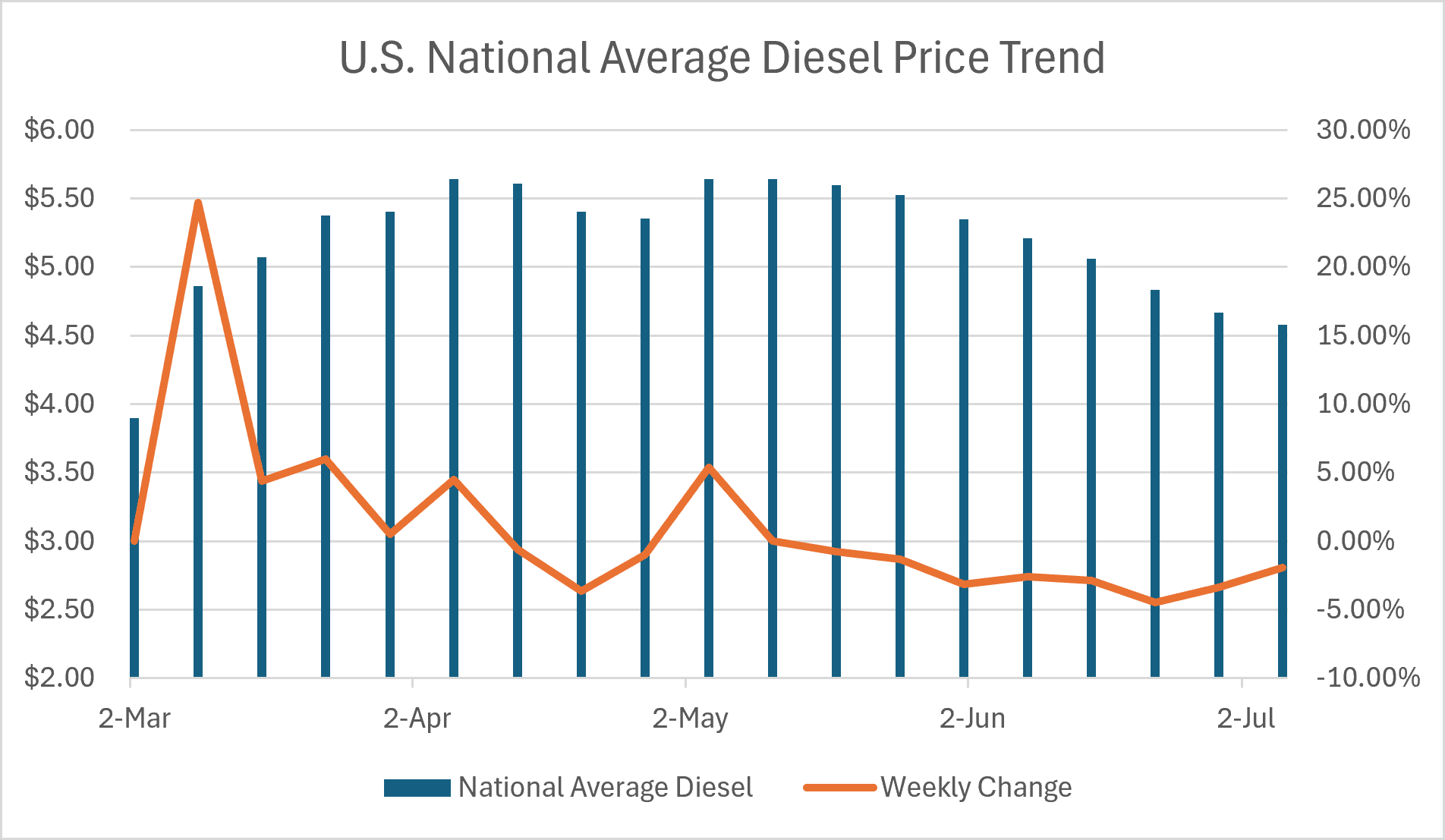
Source: EIA Weekly Retail Diesel Prices
For carriers who absorbed historic fuel increases earlier this year, that creates real breathing room. But lower diesel does not automatically mean stronger margins for two reasons.
First, $4.58 per gallon is still significantly above where diesel traded a year ago. The relief is real, and the trend is favorable, but the structural operating costs in 2026 remain materially higher than in 2024 or 2025.
Second, rapid price changes can make outdated surcharge formulas expensive in either direction. If your fuel surcharge uses a monthly average, the number may already lag the current market. If you price a load using only the posted rate per mile, you may miss the impact of deadhead, regional fuel differences, and positioning for the next load. California diesel, for reference, was still averaging $6.07 per gallon as of late June, a reminder that the national average does not reflect every operating environment equally.
Use current weekly fuel data. Recalculate your true cost per mile. Review surcharge terms before accepting freight. Diesel is giving carriers some relief. The goal now is to keep that relief in your margin.
Freight Fraud Is No Longer Just a Double Brokering Problem
The market is improving, but fraud is accelerating alongside it.
In the first six months of 2026, Verisk CargoNet estimates cargo theft losses already exceeded $359 million, with the average stolen commodity value at approximately $341,518. Those are not opportunistic thefts. These figures point to organized groups with increasingly sophisticated methods.
The shift is in how they operate. Criminal groups are now compromising carriers’ verified phone systems and gaining access to the compliance platforms brokers use to validate carriers before awarding loads, through credential theft and social engineering. The result: a fraudulent actor can appear completely legitimate at the exact moment a broker is deciding whether to tender a load.
For carriers, the risk cuts two ways. You can be the victim of a broker who never intended to pay. Or your own credentials can be used by someone else to steal freight, triggering FMCSA flags and damaging your broker relationship, issues that can take months to resolve.
Protect yourself: verify the broker’s authority, confirm their surety bond is active, and watch for any mid-conversation changes to contact information. If you see loads tied to your MC number that you never accepted, report it to FMCSA immediately.
A strong market rewards speed. It does not reward skipping verification.
Before You Accept the Load, Verify More Than the Rate
A record rate can make a load look attractive quickly. That is exactly why carriers need a stronger verification process in this market.
Before accepting freight, confirm that the broker’s authority remains active and verify its bond or trust fund status. Watch for communication that suddenly moves away from established email domains or phone numbers.
Once you pick up the freight, document it.
Photograph the load, equipment, and relevant pickup information before departure. Never accept mid-route rerouting instructions from an unverified text message or email.
Most importantly, pay attention when something does not match the original load information.
Fraud prevention often starts with small inconsistencies: a changed phone number, a rushed reroute, a different email domain, or instructions that bypass the broker contact you originally verified.
A strong freight market rewards speed. That does not mean skipping verification.
What Carriers Should Watch in July
The freight market enters the second half of 2026 with strong momentum, but four developments deserve attention.
First, watch contract repricing. Spot market strength has begun to approach contract rates, and Q3 renewals may allow carriers to renegotiate freight rates set under weaker conditions.
Second, continue monitoring diesel weekly. The decline from May provides relief, but fuel remains volatile enough to quickly change load profitability.
Third, review your USDOT registration. FMCSA temporarily paused USDOT inactivations for overdue biennial updates since June 1 due to the Motus transition. The requirement still applies, so use the additional time to review your registration and keep your information up to date.
Finally, watch for fraud activity tied to your MC number. Stolen carrier identities have become a central tactic in freight theft, and early detection can prevent criminals from using your authority across multiple loads.
The market is moving quickly. Your operational controls need to move just as fast.
A Stronger Market Can Still Create a Cash Flow Problem
Record rates create opportunity, but opportunity still requires cash.
Fuel, insurance, maintenance, and driver settlements hit your operation before many brokers pay invoices in 30 or 45 days. That timing gap becomes more important when freight improves.
More opportunity often requires more working capital. If you find a stronger lane, you still need fuel to reach it. If a high-paying load appears after an unexpected repair, you need enough cash to fix the truck and move. If your volume increases, your upfront operating expenses usually increase too.
A better freight market can put more pressure on cash flow if your payment cycle does not keep pace with your operation.
That is where freight factoring can help.
By converting delivered invoices into faster cash, factoring gives carriers more flexibility to keep trucks moving and respond to opportunities without waiting for broker payment cycles.
At Summar Financial, carriers access same-day funding with transparent terms, unlimited broker credit checks to evaluate who they haul for before accepting the next load, and a dedicated account executive. In the strongest rate market in years, the question is not only how much you earn per load, but also how much you earn per load. It is how quickly you can put that cash back to work.
Contact Summar Financial to explore how factoring fits your operation heading into Q3.