

Freight rates are higher than they were a year ago, but rising diesel prices and uneven demand are keeping trucking profit margins under pressure. For some owner-operators and small fleets, the improvement in rates hasn’t been enough to offset the cost of staying on the road.
October brought encouraging signs of a freight market recovery, alongside growing concerns about what carriers are actually earning after expenses.
Here’s what the numbers show and what they mean for trucking businesses heading into November.
Freight Rates Are Higher, but Momentum Is Slowing
Freight pricing has improved considerably compared with October 2025.
According to DAT Freight & Analytics, national average spot linehaul rates during the week ending October 24 were more than 28% higher year over year across dry van, reefer, and flatbed equipment.
| Equipment | Latest linehaul rate | Year-over-year change | Latest weekly change |
| Dry Van | $2.24/mile | +32.8% | -2¢ |
| Reefer | $2.73/mile | +31.4% | -2¢ |
| Flatbed | $2.63/mile | +28.2% | -2¢ |
Source: DAT Freight & Analytics, week ending October 24, 2026. Rates exclude fuel surcharges.
Despite those annual gains, all three equipment types lost approximately two cents per mile during the latest reporting week.
Load activity also softened. DAT reported dry van load postings down 2.1%, reefer postings down 4.7%, and flatbed postings down 1.2%.
Part of the improvement in freight pricing has come from reduced truck capacity. As carriers leave the market or scale back operations, brokers have fewer trucks available to cover loads. That can support higher rates even when freight demand is growing slowly.
For carriers, the result is a market with better pricing than last year but inconsistent opportunities from week to week.
Freight Demand Is Recovering, but Not Everywhere at Once
October brought encouraging news about freight demand.
According to the September Cass Freight Index, shipment volumes increased 1.9% year over year and 2.3% from August, marking a second consecutive month of annual growth after more than three years of declines.
The Cass Truckload Linehaul Index also rose 10.1% year over year, indicating continued improvement in freight pricing.
These figures suggest that freight demand may be stabilizing, although the recovery remains uneven.
A reefer carrier hauling produce out of the Midwest may find stronger opportunities, while a dry van carrier looking for outbound freight in Florida could still face weak rates and limited loads.
National averages help explain where the market is heading, but freight availability, equipment demand, and return-load opportunities determine what carriers can actually earn on their routes.
Diesel Is Still Putting Pressure on Carrier Margins
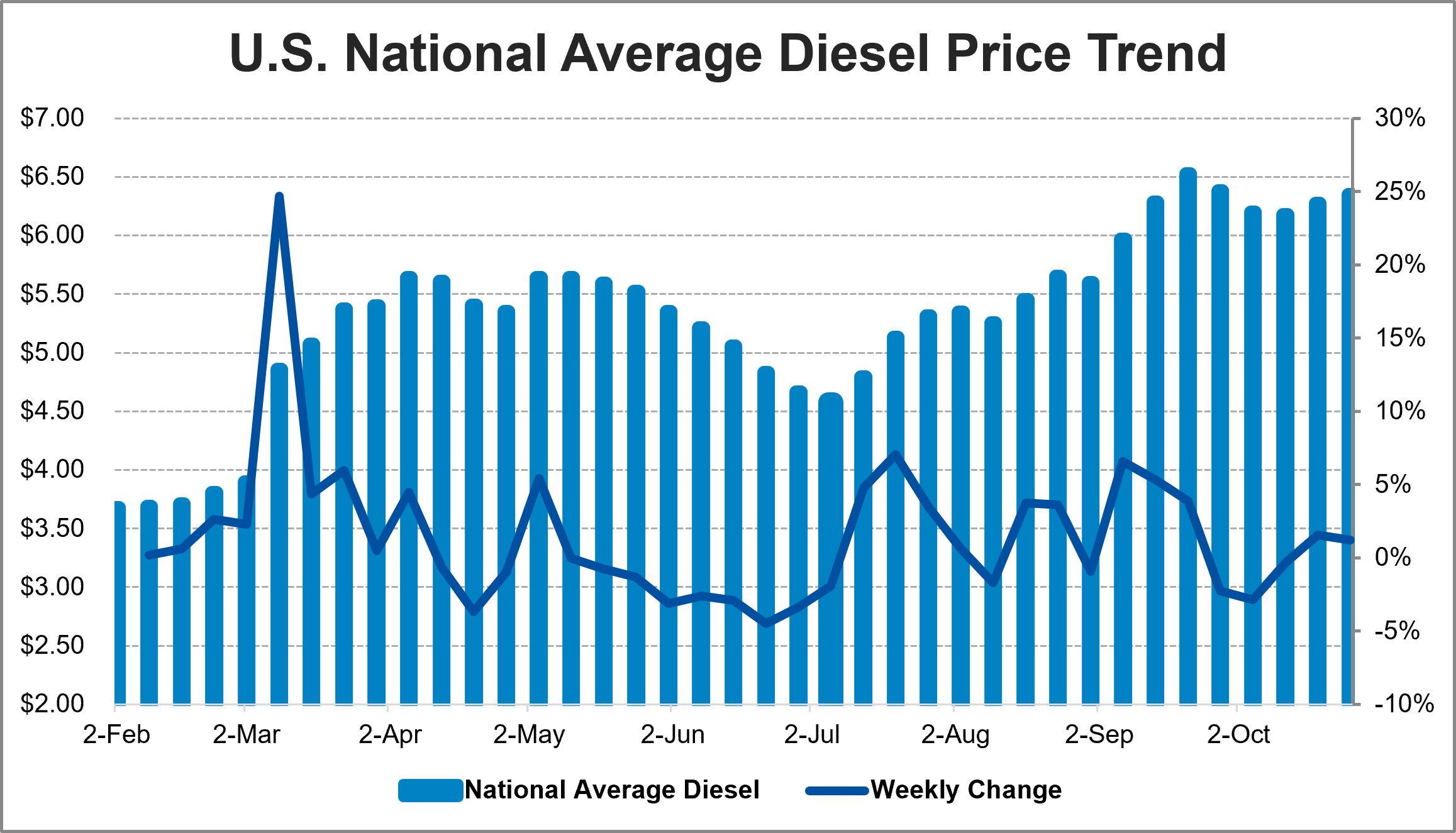
Fuel remained one of October’s biggest challenges.
According to the U.S. Energy Information Administration, national on-highway diesel averaged $6.199 per gallon on October 5 and climbed to $6.352 on October 26.
That’s an increase of 15.3 cents per gallon from the first October reading.
For a truck averaging seven miles per gallon, that increase adds approximately 2.2 cents per mile in fuel expense. At the October 26 price, the same truck would spend approximately $1,815 on diesel over 2,000 miles, before fuel discounts.
Regional differences create additional challenges. On October 26, diesel averaged $6.480 per gallon in the Midwest and $8.155 in California.
Carriers with fuel surcharges that adjust to diesel prices may be able to recover some of these increases. Those operating primarily in the spot market or under fixed-rate agreements may have less protection.
Empty miles add another expense. A carrier still burns fuel traveling to the next pickup, even when those miles generate no revenue.
With diesel prices this high, route planning and fuel-cost recovery can have a considerable impact on the profitability of a load. Comparing fuel prices along your route can also help reduce expenses. For practical tips, read our guide on how trucking companies can find the cheapest diesel.
Why Higher Rates Aren’t Translating Into Higher Profits
The pressure on owner-operators goes beyond fuel prices. Truck payments, insurance, maintenance, and other operating expenses continue whether a carrier is hauling freight or waiting for the next load.
For some, the numbers are no longer working. Individual operators have reported parking trucks or returning financed equipment, while others are adjusting their operations to avoid loads that don’t cover their costs.
The financial data helps explain why.
According to a September Overdrive report based on ATBS bookkeeping data, average owner-operator gross revenue increased 9.3% over the trailing twelve months ending June 2026.
However, approximately half of that increase was associated with higher fuel expenses and corresponding surcharges. In other words, a substantial portion of the additional revenue was needed to cover higher costs rather than increase profits.
The same concern appeared in C.H. Robinson’s October carrier observations. Carriers reported that fuel surcharges weren’t fully covering expenses related to idle time, deadhead mileage, extended routes, and temperature-controlled freight.
Some also expressed a preference for dependable, repeatable freight over higher-paying loads that involved greater operating costs.
For a small fleet, the decision isn’t always about finding the highest rate. A load with fewer empty miles, shorter waiting times, and a reliable return route may leave more money in the business than one offering a higher rate per loaded mile.
That’s why knowing the cost of each trip matters as much as negotiating the rate.
For a closer look at how cash flow influences these decisions, read Spot Market Strategy: How Cash Flow Shapes Load Choices.
What Should Carriers Watch Heading Into November?
October’s numbers point to a market that is improving, but still presents challenges for small trucking companies.
Three factors deserve attention as November approaches:
Freight demand. September’s shipment growth is encouraging, but carriers need to see whether that improvement continues. Sustained demand would provide a stronger foundation for freight rates than reduced truck capacity alone.
Diesel prices. Fuel remains a major operating expense. Carriers should monitor regional prices, review fuel surcharges, and calculate the full cost of each trip, including deadhead miles.
Lane and equipment conditions. Seasonal freight can create opportunities, particularly for refrigerated carriers, but conditions vary by region. Before accepting a load, consider where it will leave the truck and whether profitable outbound freight is available.
Better Rates Are Only Part of a Healthier Trucking Business
October’s freight market shows why stronger rates don’t always translate into better financial results.
For owner-operators and small fleets, staying profitable means understanding operating costs, choosing loads carefully, and having enough working capital to cover expenses while waiting for payment.
At Summar Financial, our freight factoring services help eligible carriers get paid for completed loads as soon as the same day. We also provide unlimited broker credit checks, dedicated account support, and non-recourse protection through Summar Shield, subject to applicable terms.
Factoring won’t make an unprofitable load profitable. But reducing the wait for invoice payments can help carriers cover operating expenses without having to accept the next available load simply because cash is running short.