

July gave carriers two clear reminders about market volatility.
Diesel fell for ten consecutive weeks, reaching $4.58 per gallon on July 6. Then it reversed, climbing to $5.31 by July 27th as tension in the Strait of Hormuz and Russia’s total diesel export ban contributed to pushing prices back up. Spot rates followed a similar path. After dry van topped contract pricing in June for the first time since February 2022, rates across all three major segments cooled through the back half of July.
A new report from the American Transportation Research Institute (ATRI) helps explain something many carriers already feel: a market that looks strong on paper doesn’t always translate into stronger margins. ATRI’s 2026 Operational Costs of Trucking report found that the average cost to run a truck hit a record $2.336 per mile in 2025, while owner-operator contract rates remained colse 2022 baseline levels.
Tight capacity has supported rates, but the broader freight environment remains uneven. The challenge is that operating costs are also rising, so a stronger rate sheet does not automatically produce a stronger bottom line.
Diesel Reversed Course and Kept Climbing
For ten straight weeks, diesel gave carriers real relief. The national average fell from May’s peak of $5.64 per gallon to $4.58 by July 6, a decline of over a dollar that eased one of 2026’s biggest cost pressures.
Then it reversed. Tension in the Strait of Hormuz and Russia’s total diesel export ban, in effect for much of July, pushed the national average up week after week: $4.80 by July 13, $5.13 by July 20, and $5.31 by July 27.
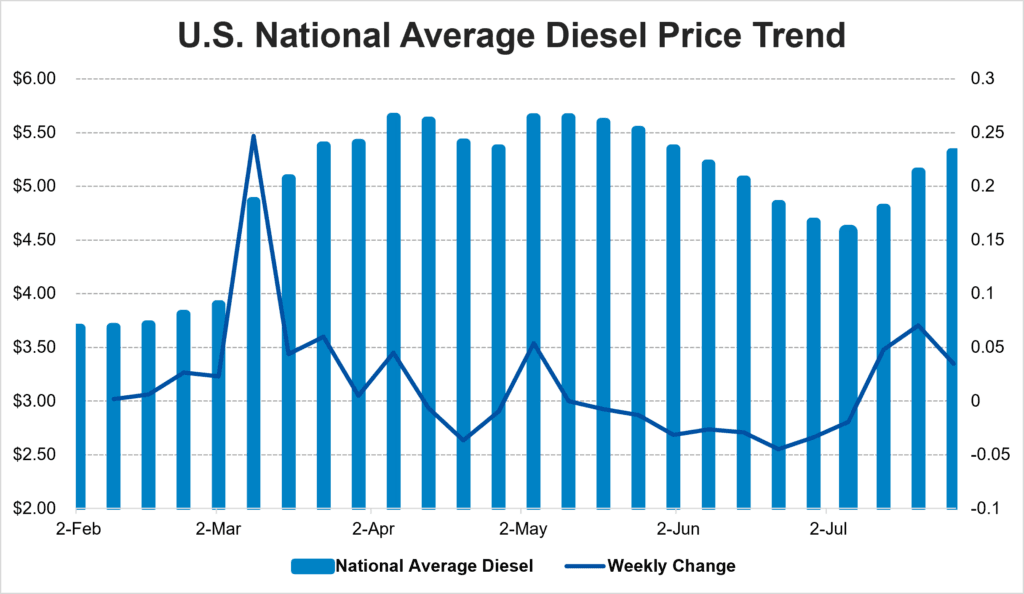
On June 9, the U.S. Energy Information Administration (EIA) projected a full-year 2026 average of $4.87 per gallon. On July 8, incorporating early-month drops, the EIA revised its forecast down to $4.61. However, diesel prices climbed $0.70 past that benchmark over the following three weeks. In its updated outlook, the EIA indicated that Hormuz shipping routes are not expected to normalize until Q3 2026, with full export volumes delayed until early 2027 (Source: U.S. Energy Information Administration (EIA)
For carriers, the practical point isn’t whether diesel is up or down this particular week. It’s that diesel rose for four straight weekly readings in July, and even a forecast published mid-month couldn’t keep pace with it. A fuel surcharge built on June’s averages, or on a forecast that’s already a few weeks old, is likely behind the market. Checking cost per mile against current weekly EIA data, rather than a monthly forecast or quarterly average, matters a lot this cycle.
Spot Rates Cooled After a Historic June
June set a benchmark few carriers expected to see this cycle. Dry van spot rates topped contract pricing for the first time since February 2022, and the reefer spot-to-contract gap widened well beyond its spring levels.
July brought that back toward a more normal range.
| Segment | Late July (All-in) | Change vs. June | What it Means |
| Dry Van | $2.38/mi | -6¢ | Spot remains healthier than early 2026 |
| Reefer | $2.72/mi | -8¢ | Produce season continues supporting demand |
| Flatbed | $2.87/mi | -8¢ | Industrial freight still provides a strong floor |
| Diesel | $5.31/gal | +73¢ since July 6 | Fuel pressure returned quickly |
(Source: DAT Freight & Analytics. Rates reflect national average all-in spot pricing including fuel surcharges.)At first glance, those numbers might suggest the market is weakening.
The broader picture says otherwise.
This is not a reversal of the broader cycle. It is a correction after a peak. Load-to-truck ratios remain well above 2025 levels, and the underlying scarcity that drove June’s numbers has not gone away. Dry van spot rates are still benefiting from the same crossover dynamic that pushed spot above contract for the first time in over three years.
The market is shifting from a period of rapid rate gains into something more disciplined, where lane selection and cost control start to matter as much as simply finding freight to move. For carriers with contract renewals approaching, the timing point is straightforward. June was a high point, not the new floor. Negotiate with July’s numbers, not June’s peak.
Read more: What Is a Healthy Operating Ratio and Profit Margin in Trucking?
ATRI Data Clarifies What’s Driving This Cycle
ATRI’s 2026 report puts hard numbers behind two things this market has shown all year: the rate recovery has gained momentum, but so too has the cost pressure underneath. While published this summer, the report provides both full-year 2025 audited baselines and early Q1 2026 data that explain the exact squeeze carriers are navigating today.
On the capacity side, carriers reduced effective capacity, meaning trucks moving freight rather than sitting registered but parked, by 5.5 percent in 2025. That was the largest single-year reduction since the freight recession began, driven by fleets shrinking outright by 2.4 percent and by 10 percent of remaining trucks left unseated for lack of profitable freight. Fewer trucks moving freight is one of the reasons rates have room to run, and that reduction hasn’t reversed.
On the cost side, the average operational cost of trucking hit $2.336 per mile in 2025, up from $2.260 the year before. Insurance, maintenance, tolls, tires, and equipment costs all continued climbing, and every major line item aside from fuel and permits rose faster than inflation. Early 2026 data shows the pattern holding into this year, with insurance premiums and fuel costs both accelerating in the first quarter.
The report also highlights a specific challenge for owner-operators. Average contracted OO rates in 2025 stayed close to where they were in 2022, even though the cost of running a truck has increased significantly since then. In practical terms, a lot of carriers are earning a similar rate for a meaningfully more expensive business to operate. Knowing your actual cost per mile, not a figure from a year or two ago, is one of the clearest ways to tell whether a load that looks profitable on the rate sheet actually is.
The Bankruptcy Wave Isn’t Slowing Down
According to Freightwaves, the small carrier exit wave that has run since January continued into July, with at least six more carriers filing Chapter 7 or Chapter 11.Some industry analysts argue that lender forbearance may be allowing financially weak carriers to remain in operation longer, potentially slowing the capacity correction.
For carriers who remain active, this creates two effects at once. There is less competition for available freight, but there is also more counterparty risk. Financial stress across the freight ecosystem also reinforces the importance of checking broker credit before accepting loads.
Congress Is Moving on Freight Fraud, Slowly
The freight fraud legislation carriers have heard about informally for months now has a formal name and number. The SAFER Transport Act (S.3950 in the Senate, sponsored by Sen. Todd Young; H.R.8267 in the House, sponsored by Rep. Brad Knott) would create a Freight Fraud and Theft Advisory Committee within DOT, require formal information sharing between DOT and the Department of Justice, and increase criminal penalties for registration fraud. It carries backing from ATA, TIA, and C.H. Robinson.
Its prospects and timeline remain uncertain, particularly as Congress approaches the 2026 midterm election period.
That means the fraud landscape carriers already navigate isn’t disappearing on its own. Overhaul’s Q1 2026 Cargo Theft Report found that while total physical cargo theft declined year over year, deceptive pickup schemes involving fake identities and forged credentials rose 31% year over year. Verification before every pickup remains the best available defense, regardless of what Congress eventually does.
The Economy Sent a Mixed Signal in July
Broader economic data released in July offered a more complicated picture than the freight market alone suggests. The Consumer Price Index fell 0.4 percent month over month in June, the largest single-month decline since April 2020, bringing annual inflation down to 3.5 percent from May’s 4.2 percent. That represented a meaningful monthly cooling, although annual inflation remained elevated.
Employment told a different story. Nonfarm payrolls rose just 57,000 in June, well below the 115,000 consensus, and May’s initially strong 172,000 figure was revised down to 129,000. Transportation and warehousing employment stayed essentially flat for the month, with no clear sign yet that carrier hiring is picking back up.
Manufacturing kept expanding. The ISM Manufacturing PMI registered 53.3 in June, a sixth consecutive month of growth, continuing to support flatbed and industrial freight demand even as the jobs report disappointed.
Put together, carriers are operating in a structurally tight market, with fewer trucks, fewer eligible drivers, and an ongoing bankruptcy wave, layered on top of an economy that is cooling on inflation but not yet clearly accelerating on employment.
Insurance Costs Keep Climbing, and ATRI’s Data Confirms It
One cost pressure that doesn’t fit neatly into rates, fuel, or fraud deserves its own mention. A July report from Cass Information Systems, citing CCJ data, found that insurance costs among the top 10 U.S. trucking companies rose 54.4 percent between 2021 and 2025, from $992 million to $1.53 billion, driven largely by large jury awards in fatal accident litigation. That increase alone cut those companies’ combined net profits nearly in half.
ATRI’s carrier-level data supports the same conclusion. Truck insurance premiums rose 3.9 percent in 2025, and litigation expenses alone, separate from premiums, ran meaningfully higher for the largest fleets, a reflection of plaintiffs targeting carriers with deeper pockets.
There is a modest silver lining. Premium renewal increases have decelerated for five straight quarters, according to the Council of Insurance Agents and Brokers. The pressure is easing slightly, though it has not reversed, and smaller carriers with less negotiating leverage still feel it more than larger fleets do.
For carriers, the takeaway is simple: insurance remains an important part of your true cost per mile and should be accounted for when evaluating rates and margins.
What Carriers Should Watch in August
First, don’t lock in a fuel surcharge based on an outdated reading. Diesel rose in four consecutive weekly reports through late July, and the EIA’s own annual forecast moved 26 cents in a single month. Review whether your fuel surcharge methodology reflects current weekly diesel movements and complies with your customer agreements.
Second, treat June as a recent high point and use a broader range of current market data when negotiating Q3 and Q4 contracts.
Third, know your real cost per mile before comparing today’s rates to past cycles. ATRI’s data shows owner-operator rates sitting close to 2022 levels while operating costs have climbed well beyond them. A rate that looks familiar on paper is not the same in practice.
Fourth, keep verifying every pickup. With deceptive pickup fraud rising and no federal legislation likely to pass this year, carrier-level verification remains the front line of defense.
Finally, take a look at insurance coverage. With litigation costs and premiums both climbing industry-wide, confirming that liability limits still make sense for the current legal environment is worth the time.
Navigating Cash Flow in a High-Cost Market
When diesel prices are highly volatile, spot rates are cooling, and operating costs keep on high, predictable cash flow is essential.
For established carriers, the question is not simply how fast you get paid. It is whether your you have a partner to help you operate efficiently and protect your margins when conditions change.
Summar Financial provides specialized freight factoring designed for carriers. You get:
- Same-Day Payments: Keep fuel cards funded and drivers paid without waiting on broker terms.
- Unlimited Free Credit Checks: Evaluate broker creditworthiness in real time before accepting loads to eliminate bad debt risk.
- Dedicated Account Support: Work directly with an assigned account excecutive who understands freight cycles, lane economics, and fleet operations.
- Transparent Pricing: Straightforward rates with zero hidden fees or back-end surprises.
In a market where every cent per mile matters, your factoring partner should do more than fund invoices. It should help you keep cash flow predictable, evaluate risk, and keep your trucks moving.
Contact Summar Financial to see how your current factoring solution compares.